
Scaffolding
Temporary structure supporting construction, maintenance, and repair work.

Neil Owen · CC BY-SA 2.0
Scaffolding, also called scaffold or staging, is a temporary structure used to support a work crew and materials to aid in the construction, maintenance and repair of buildings, bridges and all other human-made structures. Scaffolds are widely used on site to get access to heights and areas that would be otherwise hard to get to. Unsafe scaffolding has the potential to result in death or serious injury. Scaffolding is also used in adapted forms for formwork and shoring, grandstand seating, concert stages, access/viewing towers, exhibition stands, ski ramps, half pipes and art projects.
Lore & Background
Scaffolding was erected by individual firms with wildly varying standards and sizes. The process was revolutionized by Daniel Palmer Jones. Modern day scaffolding standards, practices and processes can be attributed to this man and his company: Rapid Scaffold Tie Company Ltd and Scaffolding Great Britain Ltd (SGB). Advancements in metallurgy throughout the early 20th century saw the introduction of tubular steel water pipes (instead of timber poles) with standardized dimensions, allowing for the industrial interchangeability of parts and improving the structural stability of the scaffold. The use of diagonal bracings also helped to improve stability, especially on tall buildings.
Reader's Guide
Scaffolding is a fundamental temporary structure in construction, maintenance, and repair, providing safe access to heights and areas otherwise difficult to reach. The introduction of tubular steel with standardized dimensions and diagonal bracing further enhanced stability. Scaffolding components include tubes (steel, aluminium, or composite), couplers (right-angle, swivel, putlog), and boards (timber, steel, aluminium, or laminate). Bamboo scaffolding remains common in Hong Kong, Macau, and India, using nylon straps or coir rope. The legacy of scaffolding is its essential role in enabling construction at height, with modern standards ensuring safety and interchangeability of parts.
Did You Know?
- The Berlin Foundry Cup depicts scaffolding in ancient Greece (early 5th century BC).
- Bamboo scaffolding is widely used in Hong Kong and Macau, with nylon straps tied into knots as couplers.
Ancient Origins & Early Evolution
Scaffolding's story stretches back further than most modern infrastructure. Sockets found in the walls surrounding the Paleolithic cave paintings at Lascaux suggest that some form of scaffold system was employed to reach the ceiling, a feat accomplished over 17,000 years ago. In the ancient world, the Berlin Foundry Cup provides visual evidence of scaffolding in use in early fifth-century BC Greece, while historical records confirm that Egyptians, Nubians, and Chinese builders all employed scaffold-like structures to construct tall edifices. These earliest systems were remarkably simple: wooden poles lashed together with rope knots, a method that persisted for millennia. The fundamental purpose has never changed—gaining safe access to heights and otherwise unreachable areas—but the materials and engineering behind that access have evolved dramatically from knotted rope to industrial-grade steel couplings.
The Jones Brothers & the Industrial Revolution
Before the early twentieth century, scaffolding was erected by individual firms with wildly varying standards and sizes, making the practice inconsistent and often dangerous. Two men—Daniel Palmer Jones and David Henry Jones—transformed the industry. They patented the Scaffixer in either 1907 or 1910, a coupling device far more robust than the rope that had held scaffolds together for centuries. The Scaffixer gained enormous public attention when it was used during the 1913 reconstruction of Buckingham Palace. In 1919, Palmer-Jones followed up with the improved Universal Coupler, which quickly became the industry-standard fitting and has remained so to this day. Their companies—Rapid Scaffold Tie Company Ltd, Tubular Scaffolding Company, and Scaffolding Great Britain Ltd (SGB)—laid the groundwork for modern practice. SGB brought the first frame system to market in 1944, a design deployed extensively during postwar reconstruction. Advancements in metallurgy also replaced timber poles with standardized tubular steel water pipes, enabling interchangeable parts and far greater structural stability, while diagonal bracings added critical rigidity to tall structures.
Anatomy of a Scaffold
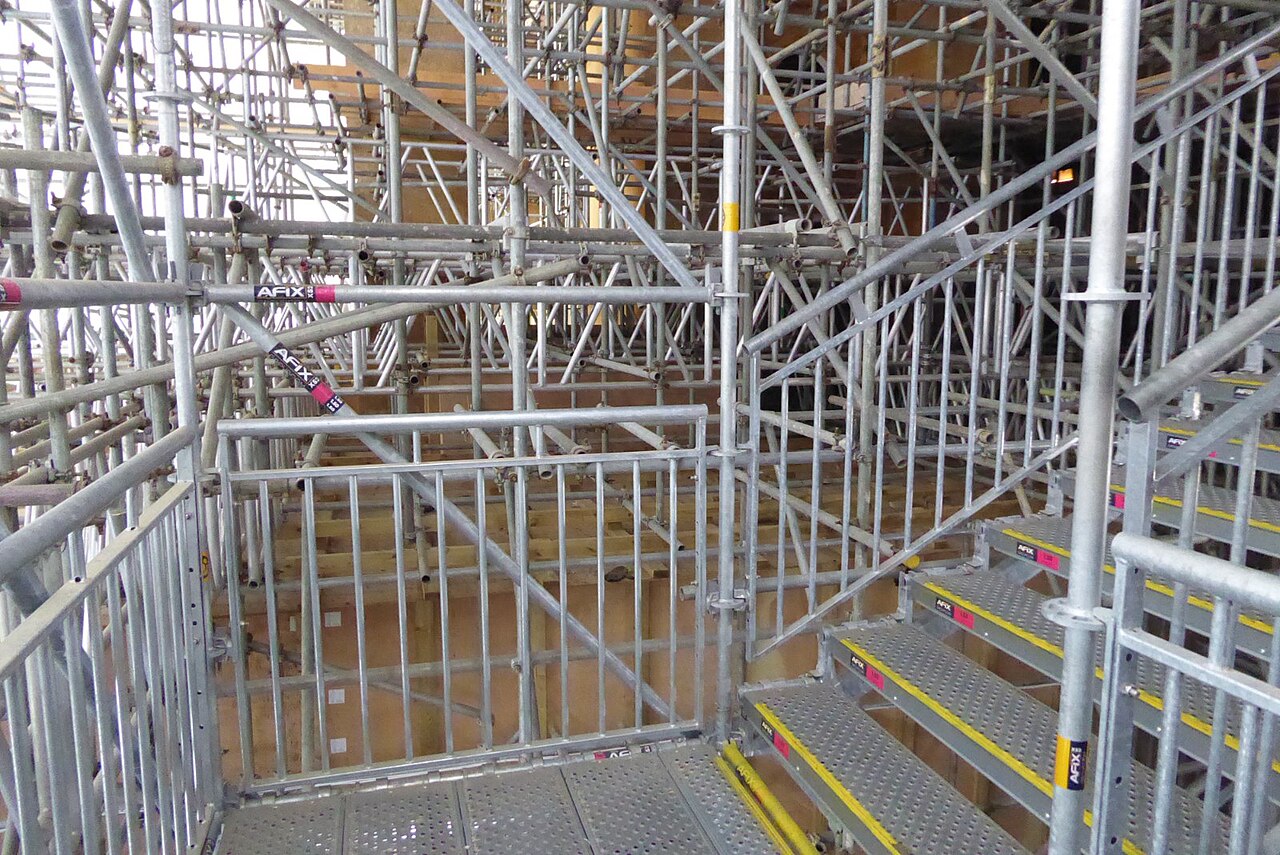
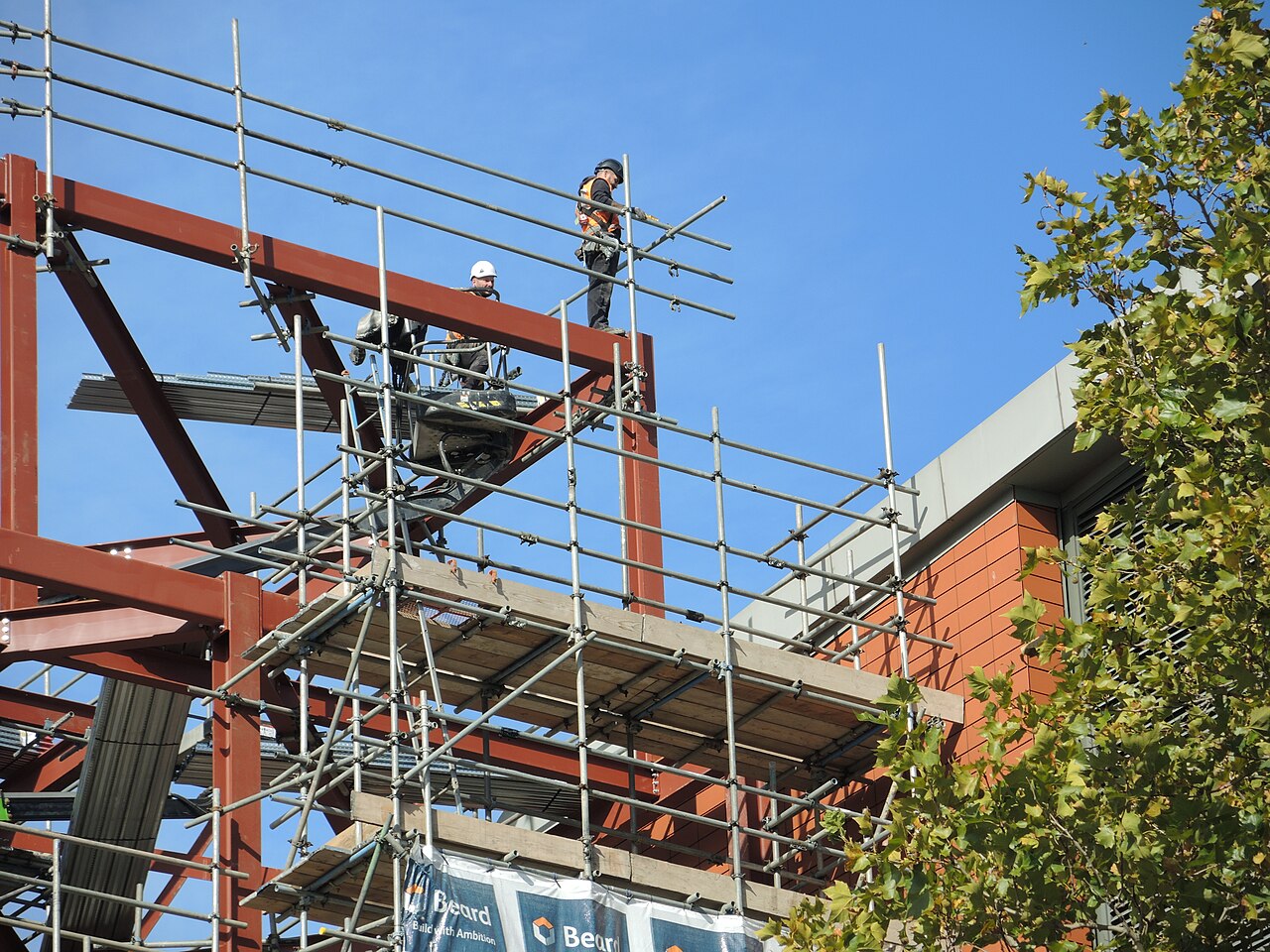
Six principal types of scaffolding serve the global construction industry today: tube-and-coupler systems, prefabricated modular components, H-frame or façade modular scaffolds, suspended scaffolds, timber scaffolds, and bamboo scaffolds—the latter particularly common in China, India, and Hong Kong. Regardless of type, most scaffolds share a common vocabulary of components. A base jack or plate bears the load at ground level. Upright standards carry vertical loads and feature connector joins. Horizontal ledgers provide bracing, while transoms serve as cross-section load-bearing members that support the batten, board, or decking forming the working platform. Diagonal or cross-section braces add rigidity. Couplers join individual components, scaffold ties anchor the structure to the adjacent building, and brackets extend platform width. Specialized additions include heavy-duty load-bearing transoms, ladders or stairway units for safe ingress and egress, beam ladders to span obstacles, and rubbish chutes for removing debris from the worksite.
Modern Materials & Standards
Today's scaffolding is governed by rigorous standards. The European Standard BS EN 12811-1 sets performance requirements and structural design methods for access and working scaffolds, applying broadly regardless of the materials used. The material palette has expanded considerably: tubes are manufactured from steel (either black or galvanised), aluminium, or composite filament-wound glass fibre in a nylon or polyester matrix. Composite tubes, though costly, are deployed specifically where overhead electric cables cannot be isolated. Steel tubes carry a standard outside diameter of 48.3 mm (1.5 NPS pipe) and are typically purchased in 6.3 m lengths before being cut to size. Aluminium offers a significant weight advantage at 1.7 kg per metre versus 4.4 kg for steel, though it is more flexible and less stress-resistant. Working platforms are built from seasoned timber boards in three thicknesses (38, 50, or 63 mm), steel or aluminium decking, or laminate. The lightweight tube scaffold marketed in the mid-1950s, requiring only a 24-pound unit and no nuts or bolts, became the industry baseline for decades.
Gallery

Frequently Asked Questions
Who is Scaffolding?
Scaffolding (also called scaffold or staging) is a temporary framework erected on construction sites to give workers safe elevated access while they build, maintain, or repair structures like buildings and bridges.
What are Scaffolding's powers/role?
Its primary function is to carry both a work crew and their materials at heights or in otherwise hard-to-reach areas. In adapted forms it also serves as formwork, shoring, grandstand seating, concert stages, viewing towers, exhibition stands, ski ramps, half pipes, and art installations.
How does Scaffolding's story end?
Scaffolding is inherently temporary; once the construction, repair, or event it supported is finished, the structure is dismantled and its components are stored or recycled for the next project.
Why is Scaffolding important?
Without scaffolding, crews would lack a safe platform to reach elevated work zones, making large-scale construction and maintenance far more dangerous. Improperly built scaffolds can cause fatal falls or serious injury, so correct assembly is a critical safety concern on every site.
More in Construction And Engineering 1-18
Spotted an error? Know more?
This is a living reference — every entry is fact-audited, and reader corrections feed straight into our audit queue. Suggest an edit · See this site's audit record