
Steelmaking
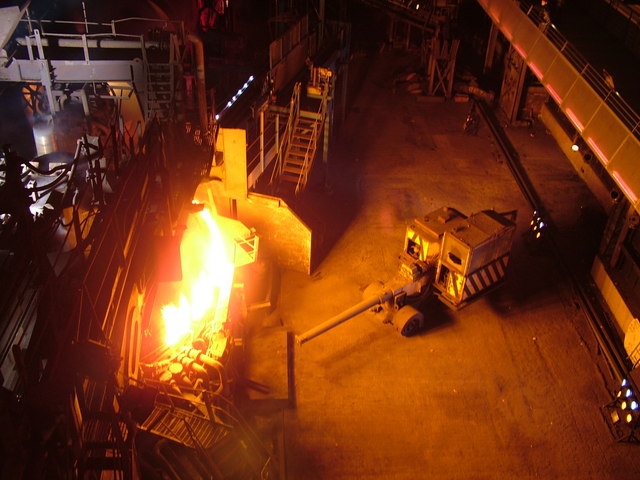
Steelmaking converts iron into steel via BOS or EAF processes.

John Goldsmith · CC BY-SA 2.0
Steelmaking is the process of producing steel from iron ore and/or scrap. It has been practiced for millennia and was commercialized on a massive scale in the 1850s and 1860s using the Bessemer and Siemens-Martin processes. Currently, two major commercial processes are used: basic oxygen steelmaking (BOS) and electric arc furnace (EAF) steelmaking.
- field
- Metallurgy / Industrial Manufacturing
- known_for
- Producing steel from iron ore and scrap; major commercial processes include BOS and EAF
- key_processes
- Basic oxygen steelmaking (BOS), Electric arc furnace (EAF), HIsarna, Hydrogen reduction
Lore & Background
Steelmaking has early roots in China, India, Rome, and northern Sweden. In Europe, the finery process developed in the 15th century, and the cementation process produced blister steel. The Bessemer process, developed in the 1850s, reduced steelmaking time to about half an hour and drastically lowered costs. By 2013, 70% of global steel output came from BOS. Electric arc furnace (EAF) steelmaking uses scrap or direct reduced iron. The HIsarna process skips the intermediary production of pig iron pellets, reducing CO2 emissions by around 20%. Hydrogen reduction allows steelmaking without fossil fuels using renewable hydrogen.
Reader's Guide
Steelmaking is central to modern industry, providing the material for construction, transportation, and manufacturing. The transition from small-scale bloomery production to the Bessemer process in the 1850s enabled mass production and integration into the global economy. Today, basic oxygen steelmaking dominates, accounting for 70% of output in 2013, while electric arc furnaces offer flexibility with scrap and direct reduced iron. The legacy of steelmaking is its transformation from a labor-intensive art to a high-volume, energy-intensive industrial process that continues to evolve toward sustainability.
Did You Know?
- The earliest known example of chromium steel production was in medieval Persia at Chahak.
- The Bessemer process reduced the time to make lower-grade steel to about half an hour.
The Alchemy of Iron and Carbon
Steel is fundamentally a marriage between iron and a trace of carbon. Pure iron on its own lacks sufficient strength, but introducing less than one percent carbon transforms the metal into something malleable, relatively easily formed, and far more versatile. This stands in stark contrast to cast iron, which is hard but brittle and resists working. The craft of steelmaking is as much about subtraction as addition: impurities like nitrogen, silicon, phosphorus, sulfur, and excess carbon—the most critical of all—must be stripped away, while deliberate alloying elements such as manganese, nickel, chromium, additional carbon, and vanadium are introduced to engineer specific grades. Each combination of these elements yields a different character and set of properties. The precise balance between what is removed and what is added is what separates a raw commodity metal from a tailored structural material capable of meeting the demands of modern industry.
A Thousand Years of Innovation
The story of steelmaking stretches back millennia, with early techniques emerging independently across China, India, Rome, and even among hunter-foragers in northern Sweden. For most of human history, steel was produced in small quantities through labor-intensive, highly skilled methods centered on the bloomery. A remarkable precursor to modern oxygen steelmaking appeared in 11th-century Song dynasty China, where Shen Kuo documented a partial-decarbonization method involving repeated forging of cast iron under a cold blast—a technique scholars like Hartwell and Needham recognize as a Bessemer predecessor. In medieval Persia, the center of Chahak produced crucible steel and represents the earliest known chromium steel. In Europe, the 15th-century finery process and the cementation method, which heated wrought iron with charcoal for up to a week, laid important groundwork. Benjamin Huntsman's 1740 crucible technique in Handsworth, England, dramatically improved both quantity and quality, though at great fuel cost. The Bessemer process of the 1850s then slashed production time to roughly half an hour and cut costs from around forty pounds to seven pounds per long ton, making steel a cornerstone of the global economy.
The Modern Three-Step Architecture
Contemporary steelmaking operates through a clearly defined three-stage architecture: primary, secondary, and tertiary processing. Primary steelmaking is where the fundamental transformation occurs—melting iron into steel. Two dominant commercial routes serve this step. Basic oxygen steelmaking takes carbon-rich pig iron produced in a blast furnace along with scrap steel as feedstock, then blows oxygen through the molten metal to oxidize excess carbon into carbon monoxide and carbon dioxide, effectively converting iron into steel. The vessel is lined with refractory materials, specifically calcium oxide and magnesium oxide, to endure the extreme heat and corrosive molten metal. The alternative route, the electric arc furnace, relies on scrap steel or direct reduced iron as its primary input. Secondary steelmaking refines the composition by adding or removing alloying agents and dissolved gases, while tertiary steelmaking shapes the molten metal into sheets, rolls, or other final forms. Over time, oxygen-based methods have grown increasingly dominant across the industry.
The Carbon Cost of Civilization's Backbone
For all its transformative role in building modern civilization, steelmaking carries a heavy environmental burden. It ranks among the most carbon-emission-intensive industries on Earth. In 2020, the sector was reported to account for seven percent of all greenhouse gas emissions from the energy sector—a staggering figure for a single manufacturing domain. The primary steelmaking routes, particularly basic oxygen steelmaking dependent on blast-furnace pig iron, are inherently energy and carbon demanding because the process requires extreme temperatures and large volumes of reductant. This has placed the industry under intense pressure to decarbonize. The sector is actively pursuing significant emission reductions, and the existing alternative of electric-arc-furnace production using scrap or direct reduced iron offers a lower-carbon pathway for a portion of output. The challenge is immense: replacing a process that has powered global industrialization for nearly two centuries while maintaining the output that infrastructure, transportation, and manufacturing depend on. The tension between steel's indispensable role and its climate footprint defines one of the defining industrial challenges of the coming decades.
Gallery
Frequently Asked Questions
What is Steelmaking?
Steelmaking is the industrial process of transforming raw iron ore and recycled scrap metal into usable steel. It sits at the intersection of metallurgy and large-scale manufacturing, serving as a backbone for modern construction and engineering.
What are Steelmaking's two primary methods?
The two dominant commercial routes today are basic oxygen steelmaking (BOS), which blows oxygen through molten iron, and electric arc furnace (EAF) steelmaking, which melts scrap using electrical arcs. Both have been the workhorses of the industry since the mid-19th-century Bessemer and Siemens-Martin breakthroughs.
When did Steelmaking become a large-scale industry?
The process has roots stretching back thousands of years, but it only became truly industrialized in the 1850s and 1860s. The introduction of the Bessemer converter and the Siemens-Martin open-hearth furnace turned steel production from a craft into a mass-manufacturing operation.
Why is Steelmaking considered so important to engineering?
It is the foundational step that turns raw ore into the structural material underpinning buildings, bridges, railways, and machinery worldwide. Without it, virtually every major construction and infrastructure project would be impossible to execute at scale.
More in Construction And Engineering 1-18
Spotted an error? Know more?
This is a living reference — every entry is fact-audited, and reader corrections feed straight into our audit queue. Suggest an edit · See this site's audit record