
Tower block
Tall residential or office buildings enabled by elevators and modern materials.

Tiia Monto · CC BY-SA 3.0
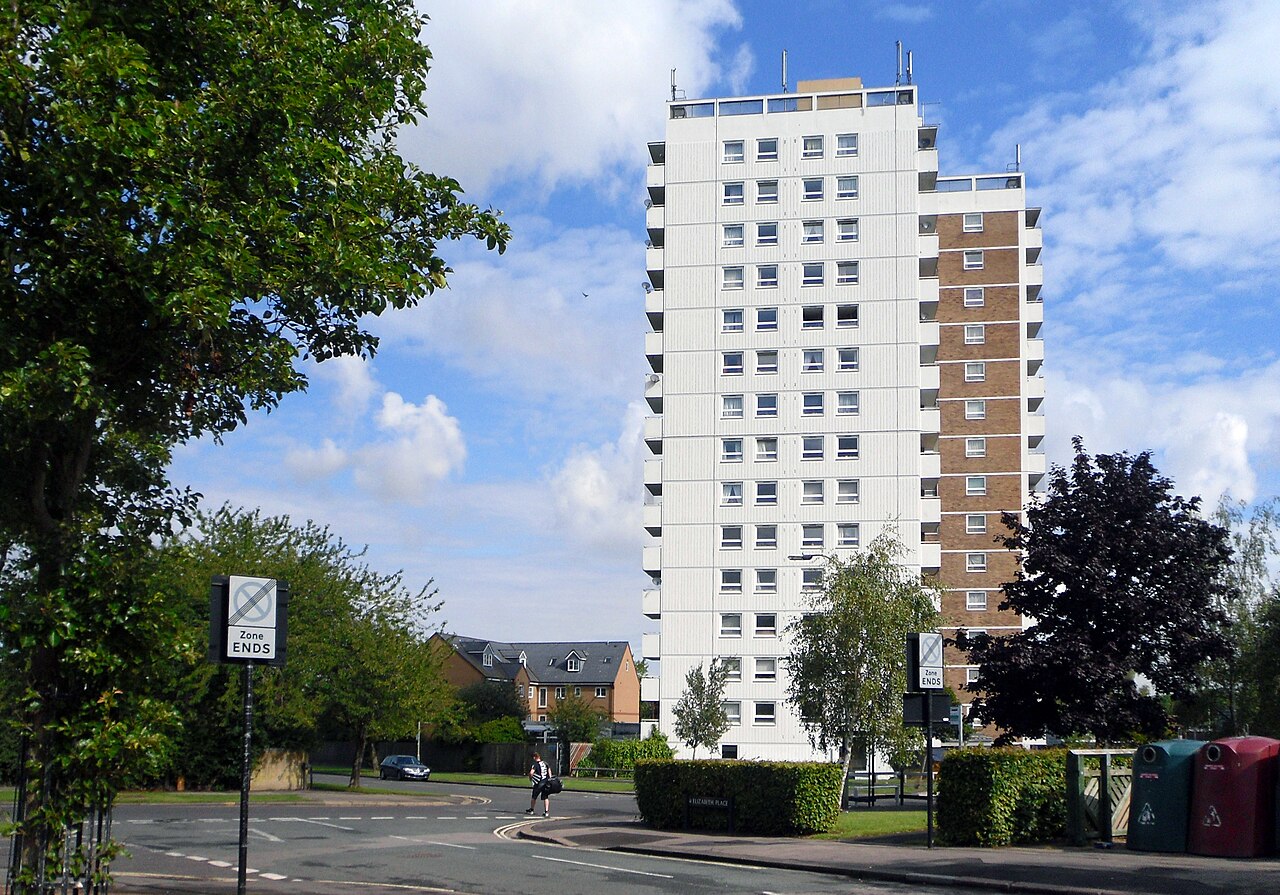
A tower block is a tall building used primarily for residential or office purposes, also known in British English as a high-rise or multi-dwelling unit (MDU). Tower blocks became feasible with the invention of the elevator and the use of reinforced concrete and steel, and they are a distinctive feature of densely populated urban areas worldwide, offering technical and economic advantages by accommodating more inhabitants per unit of land.
- definition
- A multi-story structure, often defined as over 75 feet (23 m) or about seven stories by U.S. fire codes
- materials
- Reinforced concrete and steel; residential blocks usually concrete, North American skyscrapers often steel frame
- earliest_examples
- Ancient Roman insulae up to ten or more stories; 16th-century Shibam mud-brick tower houses up to 16 stories
Lore & Background
High-rise apartment buildings appeared in antiquity, such as the insulae of Ancient Rome, some reaching ten or more stories. Roman emperors, beginning with Augustus, set height limits of 20–25 meters to prevent collapses, though these were often ignored. In Arab Egypt, the city of Fustat had seven-story residential buildings, and by the 11th century, Cairo featured structures up to 14 stories with roof gardens. The Yemeni city of Shibam, dating largely from the 16th century, contains mud-brick tower houses five to sixteen stories high, built for defense against Bedouin attacks.
Reader's Guide
These buildings were standard in housing populations displaced by slum clearances and urban renewal, often rejecting classical designs for the uniform international style. However, since the 1980s, movements like Postmodernism and New Classical Architecture have revived classical approaches. Tower blocks pose unique challenges for structural engineers, especially in seismic zones or on compressible soils, and for firefighters due to height-related evacuation and system complexities. They also require studies to address pedestrian wind comfort and wind danger, leading to designs with setbacks to reduce wind exposure and allow more daylight to reach the ground.
Did You Know?
- In the 16th century, the Yemeni city of Shibam had mud-brick tower houses rising five to sixteen stories, built to protect residents from Bedouin attacks.
- The International Conference on Fire Safety in High-Rise Buildings defined a high-rise as 'any structure where the height can have a serious impact on evacuation'.
- Most North American–style skyscrapers have a steel frame, while residential blocks are usually constructed of concrete.
Naming and Classification
Tower blocks go by many names depending on the English variety and context—apartment tower, residential tower, block of flats, MDU (multi-dwelling unit), office tower, or simply high-rise. What counts as a "high-rise" shifts dramatically by source. The New Shorter Oxford English Dictionary offers the vaguest threshold, calling any building with "many storeys" a high-rise. Emporis sets a more precise band of 35 to 100 metres or 12 to 39 floors. The National Fire Protection Association in the United States draws the line at 75 feet, roughly seven stories. The International Conference on Fire Safety frames it functionally: any structure whose height seriously complicates evacuation. Most building engineers and architects in practice use that same 75-foot benchmark. Above roughly forty stories and 150 metres, the label escalates to "skyscraper," though the boundary between the two categories remains fuzzy. A building's purpose—residential, office, hotel, retail, or mixed-use—further shapes how it is classified and discussed in professional and public discourse.
Ancient and Medieval Vertical Living
Long before steel frames and glass curtain walls, communities around the world were already stacking floors. In Ancient Rome, the insulae could climb ten stories or more, one reportedly containing 200 stairs, yet emperors from Augustus onward imposed height caps of 20 to 25 metres after poorly built towers collapsed—limits that were frequently ignored. The lower levels housed shops or wealthy families while the upper floors went to tenants of modest means. In Arab Egypt, Fustat's residential towers reached seven stories, and by the 11th century Nasir Khusraw described buildings of 14 stories crowned with roof gardens irrigated by ox-drawn water wheels. Medieval Bologna boasted 80 to 100 defensive-residential towers, the tallest still standing at 97.2 metres, while Florence in 1251 ordered all urban structures trimmed below 26 metres. In southern China, Hakka families built fortified earth dwellings called tulou, some dating to the 14th century, housing up to 80 families across five stories. Yemen's Shibam, nicknamed the "Manhattan of the desert," raised five hundred mud-brick tower houses of five to sixteen floors by the 16th century, a vertical urban plan designed to deter Bedouin raids.
Engineering, Materials, and Fire Safety
The modern tower block owes its existence to two enabling technologies: the elevator, which made upper floors practical for daily use, and the widespread availability of affordable structural materials. North American-style skyscrapers typically rely on a steel frame, whereas residential tower blocks more often use reinforced concrete. Beyond material choice, the structural and geotechnical engineering of tall buildings presents persistent difficulties, especially in seismically active regions or where underlying soils carry risks such as high compressibility or bay mud. Fire protection represents perhaps the most acute challenge: standpipe systems, HVAC design, sprinkler networks, and the evacuation of stairwells and elevators all demand careful coordination, and the very definition of "high-rise" in fire-safety contexts hinges on whether height seriously impedes evacuation. Wind behaviour is another critical concern; studies must confirm pedestrian comfort and safety at street level. To reduce wind exposure, admit more daylight to the ground, and create a visually slimmer profile, many high-rises incorporate setbacks—stepped-back upper floors that taper the silhouette as the building rises.
Urban Density and Social Function
In densely populated cities, tower blocks offer a practical answer to a simple arithmetic problem: how to house more people on less land. Compared with single-family homes or low-rise housing, apartment towers pack significantly more inhabitants into a given footprint, which in turn lowers the per-capita cost of municipal infrastructure such as roads, water, and sewage. This economic logic has made high-rise residential and office structures a defining feature of urban skylines in virtually every densely settled region of the world. Yet the social arrangement within these vertical communities has often been stratified. Roman insulae placed shops and wealthy households on the ground floors while renting upper stories to lower-income tenants; 16th-century Cairo followed a similar pattern with commercial and storage uses below and rented apartments above. In medieval Europe, the great urban towers of Bologna and San Gimignano served both defensive and status-signalling roles, while in Yemen the tower houses of Shibam were explicitly a strategy to protect residents from Bedouin attacks. Across cultures and centuries, the tower block has been as much a social and political instrument as an architectural one.
Gallery

Frequently Asked Questions
What is a tower block?
A tower block is a tall multi-story building designed mainly for housing or office use, sometimes called a high-rise or multi-dwelling unit in British English. They became practical once elevators, reinforced concrete, and steel frames made vertical construction viable.
What materials do tower blocks use?
Most residential tower blocks rely on reinforced concrete for their primary structure, while many North American skyscrapers favor a steel-frame approach. The specific material choice depends on regional building traditions and engineering preferences.
What are some of the earliest tower block examples in history?
Ancient Roman apartment buildings called insulae reached heights of ten stories or more, and 16th-century Shibam in Yemen featured mud-brick tower houses climbing up to sixteen floors. These early examples show that vertical living predates modern engineering by centuries.
More in Construction And Engineering 1-18
Spotted an error? Know more?
This is a living reference — every entry is fact-audited, and reader corrections feed straight into our audit queue. Suggest an edit · See this site's audit record